Skip to content


Two National Holidays, One Week

What could be more cumbersome to get things done and to maintain a schedule than two national holidays – one mid week, one on a weekend – in the same week? 

Independence Day celebrates the adoption of the Declaration of Independence, signaling the creation of the United States of America. It happens on July 4.  Many towns, like Chicago, have their giant fireworks displays the night before, on July 3.  July 4 is a Saturday this year; I guess that everyone is observing their day off from work on Friday, July 3 – no?

Dominion Day (or more recently, Canada Day) celebrates Queen Victoria signing the British North America Act and creating Canada. It occurs on July 1.  Knowing that this somewhat British element had to compete with mammoth American celebrations on July 4, the thought was to try to upstage this all by having the Canadian celebration a couple days earlier.

Dominion Day is Wednesday this year.  I guess that people are putting their unused vacation days and comp time towards Monday and Tuesday, not being able to wait to enjoy time off in sunshine – ?  Maybe it’s just convenient to take the whole week off. 

Who knows? It’s challenging to schedule anything this week.

Posted in History, International Affairs.


Land Development Strategy on Autopilot

First we shape our buildings, and then they shape us” 

                Sir Winston Churchill 

“Motion is the aesthetic of modern man” 

                Clifford Wiens

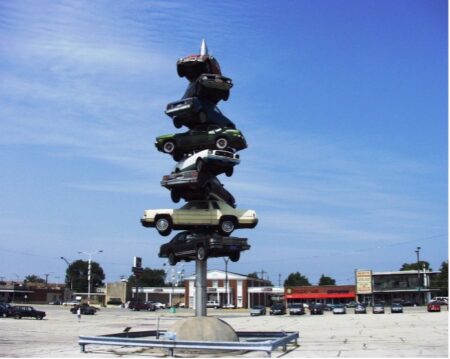
Maybe it was driving through a crowded parking lot, looking for a parking space.  In amidst the row of SUV’s there appeared to be an empty space, only to come upon it and discover that it’s simply a smaller car packed between the Escalades.  Or maybe it’s noticing the difference in scale between neighborhoods built at different decades; and that their scale varies directly with the size of their garages. Whether we want to acknowledge this or not, we’re designing our housing stock around our taste in automobiles. 

“In the Industrial Age: first we build our cars, then build our communities around them”

                Darrel Babuk

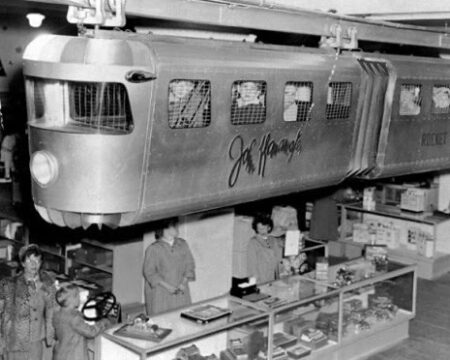
A Forward Thinking concept at the time

A Forward Thinking concept at the time

Take the ’51 Ford as example.  In retrospect, it might seem to be something akin to a lunchbucket on wheels; yet in it’s day, it was a Ford’s first revolutionary design of the modern automotive era.  Revolutionary in more ways than one; as the embodiment of the GI Housing Bill and the Interstate Highway Act of a few years later, it conquered countless acres of former rural farmland and helped populate these territories with people and commercial strips.

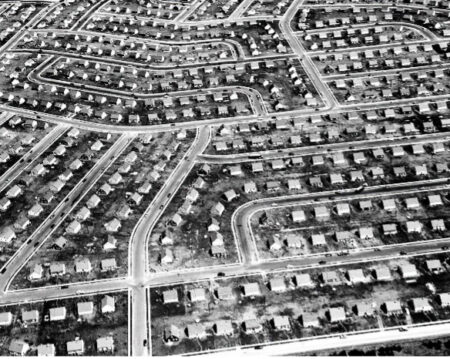
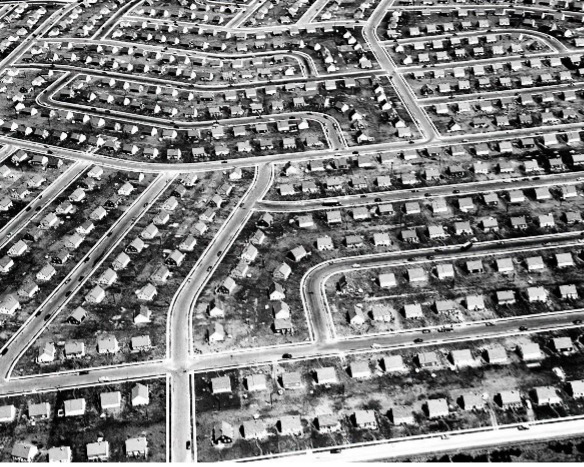
Levittown was another Forward Thinking concept of its time

Levittown was another Forward Thinking concept of its time

In 1951, the sought after housing stock was a single family home of two, maybe three bedrooms with only one gathering space not related to food.  These houses were probably configured as two separate levels, one being built inside a roof attic space to conserve materials, thus price.  It allowed its occupants to spend more money on other things, like fancier cars…

Cars had smiles in this era - this was our dentist's car

Cars had smiles in this era - this was our dentist's car

Later on, by the late 1960’s, it was commonplace to expect our cars and houses to be exuberantly flamboyant.  Houses had grown into sprawling ranches and split levels; despite experiments with swoopy rooflines, they still weren’t too large in floor area. 

Note that the roofline of this house creates the same sort of smile as did our dentist's car

Note that the roofline of this house creates the same sort of smile as did our dentist's car

Instead, individual houses sat on large plots of land, requiring cars to ferry their occupants back and forth.  The idea of a two car family had just entered American lexicon, a two car garage proudly displayed to the street was a status symbol to behold.  Cars enveloped similarly swoopy masses of sheet metal, they were difficult to manouever through city street.  Chicago reverted many of its neighborhood streets to one way traffic, to accommodate these vehicles. 

The freshness of sixties design got a bit tired, then mired in the seventies.  Maybe it was the energy crunch, or maybe it was by a series of laws that controlled, rather than encouraged design.  By the time the eighties came to be, a book by Jane Jacobs “The Death and Life of Great American Cities” came to be better accepted, and we sought ways to do more with less.  A few indulgences came in small packages.  Sudden interest in condominiums and townhouses were met by happy buyers in BMW 5 Series sedans.  Oddly, while we learned to drive more fuel efficient cars, we started to drive more cars, it really didn’t stem our consumption of resources. We rebuilt our cities, yet kept developing new suburbs. We simply found ways to use more resources. 

These days, we have McMansions and SUV’s of all sizes, though the family units that live inside the McMansions are smaller than what lived in the 50’s or 60’s tract homes. The McMansions lack design originality, though they boast rare and expensive finishes, like kitchens with granite countertops.  Didn’t the original marble cladding of the Amoco Building mine out one of Michelangelo’s historic marble quaries? Our freeways are constantly choked with traffic.  Our expectations have become supersized as we simply want more of everything – good design doesn’t really count, just that there be more of it! The car enveloped by a swoopy mass of sheet metal in the late 1960’s is no larger in floor area than a 21st century full size SUV, yet our SUV’s take up considerably more volume and weigh substantially more.  And about the original marble cladding of the Amoco Building – once it was removed due to damage, wasn’t it pulverized and used as roadbed gravel for an extension of the Stevenson Expressway?

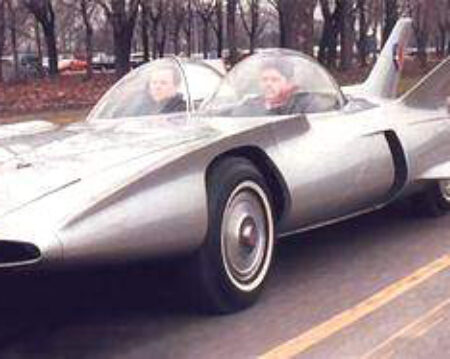
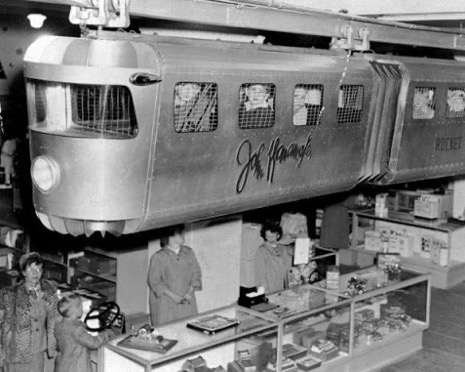
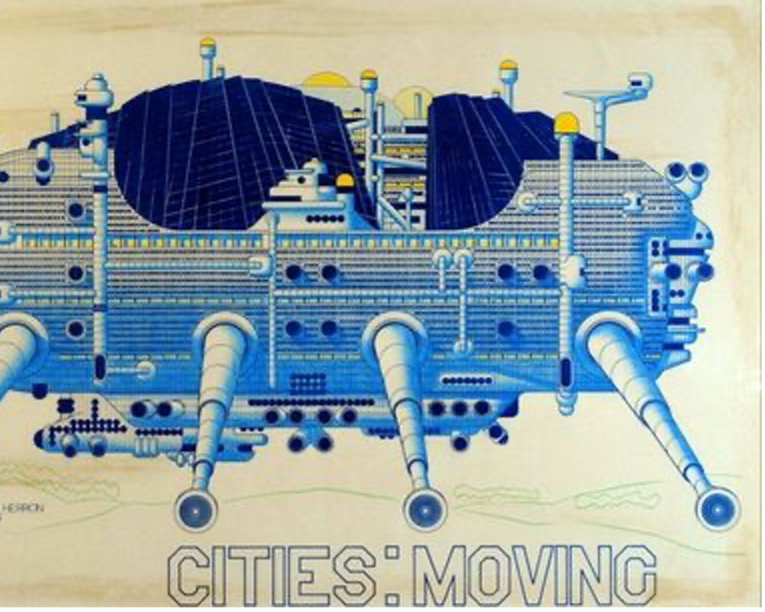
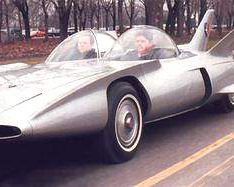
Would we have a different urban infrastructure design if we had started to drive vehicles like this?

Would we have a different urban infrastructure design if we had started to drive vehicles like this?

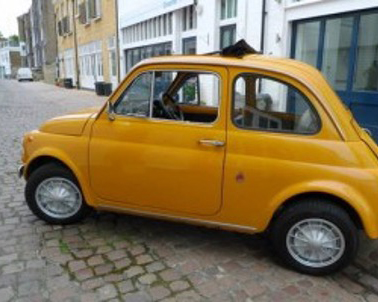
It makes one wonder about the preponderance of human nature to simply go on autopilot without question:  where would we be now if during the fifties and sixties, we had stuck not to the large cars but rather to concepts like the original Austin Mini or Fiat 500; the concepts being produced in Detroit as Ramblers or Crossleys.  Would our cities be much more geographically compact, would we be using public transit more often, and would we be living our lives in public rather than in the cocoons of gated communities?

“How often I found where I should be going, only by setting out for somewhere else”

                Buckminster Fuller

Posted in Architecture, Automobile Design, Current Affairs, History, Pop Culture, Real Estate Development.


The “Architect – Comedian” as the next new comic sensation

At a farewell party last night, one fellow picked a conversation topic started expounding on “lawyer-comedians”.

Now, I can count lawyers as being among my best of friends, however:  a “lawyer – comedian” sounded as oxymoronic as would an “architect-comedian”.  I somehow doubt if anyone could find comedy in issuing a change order or an Expression of Interest document.

Thinking of it, until very lately, the only architects ever depicted on prime time television programs were the likes of Mr. Brady of “The Brady Bunch”, or the owner of “Mr. Ed – the Talking Horse” – all these characters being rather contrived.  For television, the images of lawyers have been dressed up by inserting a bit of drama into their daily routines – a procedural time out while appealing a stay of execution, for example.  We architects could never inject excitement into a Contemplated Change Notice addressing plastic laminate countertop surfaces. 

The only group less likely than “lawyer – comedians” or architect – comedians” may be an “accountant – comedian”, perhaps developing comedy in changing the standard office ledger paper from six column to five.  A cost effective move, no doubt.

Fortunately, we found a more entertaining conversation topic that involved commenting on wine from Ontario vineyards.

Posted in Architecture, Current Affairs, Pop Culture, Speaking Engagements.


Sustainability and recent wood technology

It was fascinating to see a recent proposal for the Sears Tower to include all glass ‘look out pods” – a cantilevered glass structure of nothing but glass on five sides including the floor and all supporting structure.  No apparent supporting structure – or at least what we would think to be supporting structure, like steel – at all. An architect who interned under me years ago became fascinated with all glass structures and developed this into a market segment, designing things like all glass stairways and all glass trusses – very showy stuff.  The way he explained it was simple: glass is a material whose structural qualities are much like concrete – excellent in compression, limited in tension, not great in shear. A major difference between glass and concrete is that one can’t cast an eight inch thick slab of glass in whatever shape with reinforcing bars, the fabrication method is that different. 

Glass Stairway, Chicago

Glass Stairway, Chicago

One only need to look at the glass staircase in the Macintosh computer store on North Michigan Avenue, an all glass stairway whose stair treads are perhaps an inch thick.  Imagine a slab of concrete one inch thick, and one probably could envision patio blocks.  Not the sort of material that one could use to span an entire stairway width.

The same comparisons are true for wood products.  I was invited to attend a seminar held by the Canadian Wood Council and the Forest Products Association of Canada last Thursday. Wood has good compressive and tensile properties.  In Chicago, it tends to get overlooked due to this fire we had back in 1871, before the days of building codes and fire-resistivity research.  A professor of mine once described it this way – if you were given a choice a sitting under a flaming steel beam or a flaming wood beam, which would you rather?  Steel melts when heated, whereas heavy timber develops a protective char, preventing further damage. When used properly, wood can be safer than steel.

While wood may be a piece of tree shaved down to a dimension, modern wood technology is based on taking smaller, perhaps scrap pieces of wood and gluing them together in a way that aligns the direction of wood grain to perform to specifications.  Wood itself is composed of directional fiber and cellulose, the cellulose acting as glue. Today’s methods essentially take wood fiber and glue them back together with engineered resins.

2010 Winter Olympics Speedskating Oval, Richmond, BC

2010 Winter Olympics Speedskating Oval, Richmond, BC

The new 2010 Winter Olympics Speedskating Oval in Richmond, BC is the world’s largest all-wood structure.  Its graceful, curving roof is made up of many pieces of wood, glued and bolted together. By understanding the importance of structural shape and direction of wood grain, the graceful curves allow impressive spans. A “V” truss shape incorporates fire sprinklers.

Murray Grove, London, UK

Murray Grove, London, UK

One of the more dramatic displays came with a British project, Murray Grove, a nine story apartment building in London, constructed entirely of cross laminated timber panels.  Imagine plywood but six inches thick.  This system could be constructed to be even taller; it offers many sustainability advantages over steel or concrete systems. 

Murray Grove Construction

Murray Grove Construction

Murray Grove, Panel Diagram

Murray Grove, Panel Diagram

 This system met or exceeded all firecodes, provided ease of constructability and negligible construction waste. 

Using proper connections, wood construction of this type offers superior seismic resistive cabilities, as entire panels can absord twisting without breaking.

Some people think that wood is like taking a chain saw and killing a tree.  Not so.  The amount of energy, water and carbon involved in making wood from seedling to reforestation in a properly managed forest is less than what it would take to make a unit of steel or concrete.  Trees are most efficient at producing oxygen up to a certain point in their lifespans.  A properly managed forest respects this and will target selective trees for harvest while supporting the ecosystem, much like how nature takes care of itself. 

Canadian forests consistently rank among the world’s best managed and best documented, managing a small portion of forest while leaving the majority of forests in their natural state.  This approach makes wood a highly sustainable building product that is just beginning to be recognized by the “green” industry.

Posted in Architecture, sustainability.


The Illinois Saint Andrew Society Highland Games British Car Show

The good hostess favours of rain ponchos the evening previous was an omen indeed.  Unprecedented 70 mph winds and heavy downpour rains swept through the area.  Upon checking email at 430 on Saturday morning, a note read “.. the Games will go on..”

Just a wee bit of the 7000 pounds of this 1953 Bentley R-Series

Just a wee bit of the 7000 pounds of this 1953 Bentley R-Series

The Illinois Saint Andrew Society is the oldest and longest continually operating charity in the State; it’s like a Scottish benevolent society.  For the past twenty-three years, it has staged the Highland Games – heavy athletics, rugby, soccer, dancing competitions, shortbread baking contests, dog shows, sheep herding… For the past few years, the program has been expanded to include a British Car Show.  I am honoured to Chair the committee that organizes the car show within the overall Highland Games Committee.  The British Car Show Committee led to the formation of the Scottish Motor Club, an organization that can continually promote the Highland Games, the Illinois Saint Andrew Society, and offer moral support to anyone relatively new to Lucas Electronics.

Looking down the Car Show Row, early in the morning

Looking down the Car Show Row, early in the morning

The Highland Games were held at the Oak Brook Polo Grounds. The grounds are being converted from polo accommodations to soccer; a seemingly insignificant though very major change is that soccer fields have longer cut grass that tends to retain water.  The thought that came to mind is that kilts are always preferable to trousers when marching through wetlands. The grounds were awfully soggy at 6AM. 

Lotus Europa (left) Lotus Super Seven (Right)

Lotus Europa (left) Lotus Super Seven (Right)

Nightmarish thoughts of low-slung Lotuses (Lotii ? ) and 7000 pound Bentleys came to mind.  The Village of Oak Brook was quick to disallow cars on the main field; the car show had to quickly relocate.  After an impromptu committee meeting, a well drained site along the main walkway to the admission gates was chosen.  Though a bit tight in area, it had exceptional visibility and even offered shade.  The Highland Games are highland games first and a car show second, so cars are never a major bill.  This year however, despite overnight flooding and fallen trees leaving neighbourhoods in disrepair, some seventeen cars appeared.  None sank in the mud, as our site had no mud to sink into.

Not a Sunbeam Imp, but rather a 1973 Land Rover Series III

Not a Sunbeam Imp, but rather a 1973 Land Rover Series III

The Arts & Culture Club of the Saint Andrew Society invited me to make a presentation describing Scottish cars.  There were Scottish Americans who formed automobile companies like Winton, Buick, then General Motors; and there was the Rootes Group who built a factory at Linwood, Renfrewshire, Scotland that manufactured Hillman Imps (mainly) with the occasional Sunbeam Alpine and Humber Scepter coming off the line.

1963 Sunbeam Imp, photo from the 2008 Highland games British Car Show

1963 Sunbeam Imp, photo from the 2008 Highland Games British Car Show

Midway through the afternoon, a friend’s Sunbeam Imp (as badged in the US) appeared, making the display complete.

Another friend contacted me earlier, I had asked if he could bring his 1929 Austin, as we didn’t have any pre-war British cars showing.  He returned the contact indicating that a friend of his was letting him use his racetrack to try out his McLaren F1.  This constitutes quite an acceptable reason for not attending the Highland Games British Car Show.

Lotus Elise

Lotus Elise

Early in morning however, my daughter won First Place for dancing the Flora, and Second Place for the Sword Dance!

A good time was had by all, with the Lotus Corps Chicago attempting to convince me that my next car should be a Lotus M100, while people from New Zealand approached me, actually recognizing my car as a Clubman Mini, and sharing stories.

Posted in Automobile Design, Community Organization, International Affairs, Speaking Engagements.


The Burnham Plan Centennial Opening Events Reception

A reception and concert was held on Friday, June 19 in Chicago to commemorate the 100th anniversary of the Burnham Plan for the City of Chicago.  These events coincided with the opening of two Millennium Park pavilions that capture the essence of the Burnham Plan of 1909, and marked the start of an entire season of cultural events and presentations.

The Burnham Plan was visionary.  It envisioned a prairie metropolis with public lakeshore and efficient transit; with sustainable growth and economic muscle. It spawned the now famous phrase “..make no small plans..”

Before heading into the reception, I took a quick peak at the two pavilions, located on the opposite side of the Jay Pritzer Pavilion; the Frank Gehry designed bandshell and open air theatre.

Burnham Pavilion, UNStudio, Amsterdam

Burnham Pavilion, UNStudio, Amsterdam

The rectilinear pavilion designed by Amsterdam Architect  Ben van Berkel of UNStudio is a created slot of air and sky. People could wander through the square pavilion with its diagonal pilotis gracefully piercing through a solid sky of painted surface.  The upward floor lights of changing colour reinforced the experience.

Foreground: Burnham Pavilion, UNStudio, Amsterdam.  Background: Burnham Pavilion, Zaha Hadid, London

Foreground: Burnham Pavilion, UNStudio, Amsterdam. Background: Burnham Pavilion, Zaha Hadid, London

The oblong pavilion design by London Architect Zaha Hadid was an ambitious ‘clam’ of fluid space.  Its tenuous frame sat adroitly at the site, waiting for its fabric skin.  “..it was a bit more complicated than originally thought…” was a comment heard.  When finished, a multimedia presentation displayed on the fabric would give a never-ending show of Chicago.

Burnham pavilion, Zaha Hadid, London

Burnham Pavilion, Zaha Hadid, London

Both pavilions presented strong, though concepts of “sky” – an important feature in a prairie city.

At the reception, civic officials and leaders, history aficionados and those who work to carry on the Burnham Plan were in attendance, under a mammoth tent erected just behind the new Harris Theater on Randolph Street.  How a kid from the Canadian Prairies could ever wind up in an event like this is beyond me though not up for question.  I renewed several contacts connected with Great Chicago Places and Spaces, and discussed potential format changes for next year.  I also had the chance to tell the visiting Oak Park municipal delegation about my Secret Streets of the Loop presentation, and the concept behind those streets.

In a completely separate conversation, one said “..I’m off to an event with air conditioning..”, it was rather sticky weather, though many times I’m just a bit intolerant of weather like, my internal thermostat seems permanently stuck on the high plains.  The Chicago Loop had been hit by a nasty rain storm earlier, at noon; it left everything humid under a dark sky.  As the crowd was being ushered towards the Pritzker Pavilion, rain ponchos were being handed out as good hostess favours.  Perhaps a telling omen.

DSC00225

Posted in Architecture, Urban Planning.


Scottish Motor Club Oak Park Avenue British Car Show

The Scottish Motor Club is comprised of Illinois Saint Andrew Society members who own classic British cars and look for excuses to get them out of the garage now again.  In doing so, we promote the Society, its goals and its programs.  I chair this group.  Our major event is the Highland Games British Car Show, held this year at the Oak Brook Polo Grounds.  We attend other events throughout the year, and this year, we decided to hold a ‘pre-event’ in a neighbouring community to promote the Saint Andrew Society and the Highland Games. The Oak Park Avenue Business Association is a group I know. I used to hold membership in this organization when my practice was located in Scoville Square in Oak Park. 

DSC00213By using a few contacts I know on the Avenue; the Scottish Motor Club made a presentation to the Association to stage a car show with accompanying events.  Two other businesses on the Avenue, the K9 Cookie Company and The Irish Shop helped us on this presentation. The Magic Tree Bookstore lent support and their facilities, as did the management of Scoville Square. The Wednesday Journal newspaper gave publicity. With all approvals in place, and with an effort of heroic proportions mounted by the manager of Cucino Paradiso who secured a street closure permit, the show went on as planned.

1967 MGB-GT

1967 MGB-GT

On the afternoon of July 14, like clockwork, Oak Park Avenue between Lake Street and North Boulevard was closed down, and about sixteen or so British cars and a motorcycle appeared, as did a client who drove his 1963 Lincoln Continental ( let’s see – this was the basis for the US presidential limousine, it saw a lot of international exposure: ok, we’ll let it in! ). 

1957 MGA "hotrod"

1957 MGA "hotrod"

It was a great collection – an MGA and an MGB-GT, a couple Jaguar XKE’s and a classic Jaguar XK150, a Triumph TR3 and Spitfire, a bunch of Lotus Europa’s and assorted other cars. 

Not even counting the 1967 Sunbeam Tiger that kept driving around but never stopping, we had fifteen or so cars appear – real cars, not counting the folded-paper model cars that were displayed through the Chameleon Clothing Company

1973 Jaguar XKE 2+2

1973 Jaguar XKE 2+2

The K9 Cookie Company joined with the Oak Park Animal Care League to stage a dog show with an interactive exhibit identifying the thirteen breeds of dogs from Scotland, they both invited friends with dogs to bring them to the Avenue and parade them around.  The Thistle and Heather Highland Dancers made an appearance, then the City of Chicago Pipe Band ( who practice around the corner at Grace Episcopal Church ) marched onto the Avenue and played, eventually the highland dancers started dancing flings to the pipe band, and then sword dances – at one point, there were about 200 people watching.

The Thistle and Heather Highland Dancers with the City of Chicago Pipe Band

The Thistle and Heather Highland Dancers with the City of Chicago Pipe Band

It was quite the afternoon of activities.  All was so successful that no one even noticed that this was an entirely volunteered event – no one was paid anything for their energies other than hearty gratitude and applause.

Thank you!

Posted in Automobile Design, Community Organization, International Affairs.


Scientific Research and Experimental Development Tax Credit Seminar

At the invitation of the Ontario government trade representative to Chicago, I attended the Scientific Research and Experimental Tax (SR&ED) seminar last Friday, June 12.  It was held at the Mid-America Club, on top of the Amoco Building / Aon Center / Standard Oil Tower / whatever that building is known as these days.

The seminar was hosted by various Canadian, Ontario and Quebec government entities.  While the amount of information concerning this topic was only ‘scratched’ during this presentation, it still seemed to be a  rather exhaustive description of the type of tax credits out there; the types of research that may be funded by tax credits and the criteria that fundable research must meet.

Posted in International Affairs.


Canada, as a Presentation and as a Networking Organization

Friday, 5 June 2009

A few weeks ago, I was approached by a relocation service to make a presentation describing Canadian history, government and culture to a family moving to Canada.  While I do many public speaking engagements throughout the year, this was the first time I had been invited to speak on this topic.  It took a bit of research outside of my typical sources, especially when one of the questions related to federal vs. provincial responsibilities described in the Canadian Charter of Rights and Freedoms, and the historical basis for how this came to be.

It seemed that a presentation like this required a learned academic; however, I had been recommended by a source who would know better.  I was quite flattered to have been asked, and to have delivered a presentation like this.  The presentation was held today, and it was most enjoyable.  The audience and client appreciated the talk as well.

Afterwards, I had been invited to attend an organizational meeting of the US / Canada Business Council, for which I participated.  This group – to be part of the Canadian Club of Chicago – will work to foster networking and understanding between US and Canadian business communities.  A relevant concept with many possibilities, I’m happy to be part of its founding.  We threw around several ideas for organizational concepts and potential events, with the goal of a September inaugural event.  Things are slow for Chicago’s business networking community during summer.  More later.

Posted in Community Organization, International Affairs.


Forecasting Global Economic Strategy, Understanding Urban Planning and the 1977 Mini Clubman Estate

Wednesday, June 3, 2009

While I’ve been avoiding the temptation, the removal of General Motors from the Dow Jones Index may provide a good reason to describe my own car, to draw parallels to the direction of this economy, and to the future of urban planning, of all things.

Both General Motors and Citi Group were recently removed from the Dow Jones Index, and replaced with Travellers Insurance and Cisco Systems.  One could argue that the financial conditions of both GM and Citi had made them dead weight, they were not reflective of the US economy.  It was curious that General Motors was not being replaced by another car company.  Could it be that the automobile industry is not being seen as the driver (pardon the pun) of the overall economy that it once was?

1977 Mini Clubman Estate

1977 Mini Clubman Estate

Now, I drive a 1977 Mini Clubman Estate complete with right hand drive and British plates.

People stop me on the street and ask what it is ( “a car” ).

Some ask what kind of mileage it gets ( ” about forty in town” ).

Others ask if it’s legal to drive something with the steering wheel on the wrong side ( “of course it is, I’m driving on the right side” ).

Still others: how fast can it go? ( “I’ve had it opened up at 65″ )

And still others wonder if it’s safe on the same road as giant SUV’s.  Why one feels a need to drive a mammoth SUV in the middle of a large city and try to park it somewhere is beyond me.  My Mini Clubman Estate belongs in a big city.  That said, we don’t live in a big city, nor do we make a living by hauling things.  The Mini wouldn’t be at all appropriate there, or in places where snowdrifts are bigger than it is.

In 1959, Minis were produced by the British Motor Corporation, sometimes known as Austin – Morris.  It was designed by a team led by Sir Alec Issigonis during a one week design charette and was a revolution automotive concept – the absolute minimum car possible to transport four people.  In 1969, a jazzed up version, the Clubman, was introduced.  It had a flattened front to appear more modernand several trim upgrades.  Like the regular Mini, the Clubman also came in a “wagon” version, the “Estate”. A Mini Clubman Estate Estate is what I drive.

If it didn’t make so much sense, it would be fun.  Maybe it’s so fun because it pushes one’s bounds of tolerance so much.

In fact, my Mini makes perfect sense as something to be driven in the city.  Asides from great mileage, it takes up less space and can manoeuvre around some of the tightest places.  From an urban planning standpoint, our cities have been designed and redesigned around transportation.  In recent memory, cities have come to be designed around cars.

Combining examples from previous posts and from my “Secret Streets of Chicago’s Loop” presentation, one can point at the original layout of the Chicago Loop.  It was designed around slower modes of transportation supporting a smaller population. It was eventually necessary to accommodate faster and heavier modes of transportation, the Great Fire providing a clean palate for redesign.  The solution was to widen every second street with the other streets left as original.

One of Chicago's Original Streets

Arcade Place at LaSalle Street, Chicago

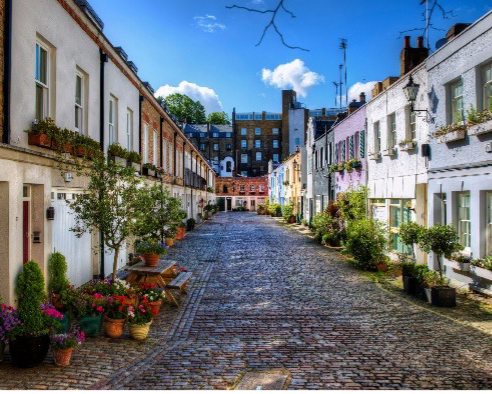
Street upgrades have continued to accommodate faster modes of transportation, and to accommodate more traffic generated by a larger population base. The avenues that became primary streets of Chicago’s Loop are big and wide, able to accommodate the largest of vehicle.  Out in the suburbs, where traffic travels even faster, streets are much wider and consume far more land while oddly supporting a sparser density.  Back in Chicago, the remaining narrower streets – several of which still contain storefronts – make my Mini feel right at home. It’s a great example of designing streets around and the scale of our cities around the transportation we use.  Going further, several sections of Chicago’s “L” use little more than a back alley’s right of way, while a subway can snake its way around, virtually unknown.

But I digress – enough about urban planning and back to my Mini and its irony concerning our economic direction…

By the time my Mini was built in 1977, the British Leyland Corporation was making itself more apparent.  A variety of British marques were having difficult economic times, so the British Government and other parties stepped in, consolidated models, cut costs and proceeded on.  While the Countryman version of a Mini came with real wood trim, the Clubman Estate came with a “swoosh” of fake wood trim along each side.  Most Mini Clubman Estates came off the assembly line painted a “Harvest Gold” beige kind of colour with dark brown velour upholstery – the sort of fabric of jammies sold at Woolco that wound up under the Christmas tree. One would gather that producing many cars in one colour would reduce costs.  As the model progressed on in years, many components came to be made from cheaper and cheaper materials.  The marque’s image took a hit.

It took a solid change of course to right the Mini’s image – drop the Clubman, improve quality, and to build on the ‘fun’ aspect by producing special “themed” models.

If one were to change a couple names, this story may seem much like a drama being played out in Detroit as of this writing.  Emotional connection to automobiles aside, indicators may be saying that the automobile industry isn’t going to play the major part in a manufacturing economy that it once did. Perhaps our cities have reached a point where traditional transportation systems are maxed out, and we need to return to mass transit to make our cities liveable.

Will the automobile ever regain its influence on the economy?  Perhaps not. Getting around and moving about will continue to be a driver of the economy.  The mode of transportation will simply have changed.

This begs the question: if Cisco replaced General Motors, are Wall Street’s forecasters envisioning that electronic communications will replace physically moving people from one place to another and that social skill known in Chicago as “schmoozing” ? I hope not.

Posted in Architecture, Automobile Design, History, Real Estate Development, Transit, Urban Planning.